A practical guide for Burlington, Graham, Mebane, and Alamance County homeowners
If you have spotted a large, chunky rodent waddling in and out from under your deck or noticed a wide hole with a fresh pile of dirt at the edge of your porch, there is a good chance a groundhog has moved in. They are common across Alamance County’s Piedmont landscape, active from late February through October, and far more destructive to your property’s structural integrity than most homeowners expect. The sooner you address it, the less damage you will be dealing with.
Groundhogs, also known as woodchucks or whistlepigs, are the largest members of the squirrel family. They weigh between 5 and 12 pounds, live primarily underground, and build burrow systems that can extend 15 to 25 feet in length with multiple entrances and internal chambers, according to the North Carolina Wildlife Resources Commission (NCWRC). The protected, shaded space under a deck or porch is almost exactly what a groundhog is looking for: overhead cover, stable ground for digging, close proximity to food, and minimal human foot traffic.
From yours, it is a structural liability sitting on top of an excavation project.
How Much Damage Can a Groundhog Really Do?
This is the part most homeowners underestimate. Groundhogs are not nibbling at the edges of your yard. They are engineers, and their engineering is working directly against your deck’s foundation.
A single groundhog can move 700 pounds or more of soil while constructing and expanding its burrow system. Tunnels running under deck footings and support posts remove the compacted soil those structures depend on for stability. Over time, this creates voids beneath your deck frame, allows water to redirect and pool under the structure, and causes uneven settling that shows up as sagging boards, misaligned steps, and posts that have shifted out of plumb.
Groundhog burrows can reach up to 5 feet deep and run 25 feet or more in length, often with multiple exit tunnels branching off the main channel. A burrow that starts at the edge of your deck can reach your foundation, porch footings, or even utility lines beneath the yard.
The structural damage is not always visible from above. Many homeowners discover the extent of the problem only after the ground settles enough to cause a deck board to crack, a step to tilt, or a support post to lean. By that point, the burrow is well established and the animal has likely been living there for months.
Additional damage groundhogs cause on Alamance County properties:
- Underground utility lines and irrigation. Groundhogs chew through whatever crosses their path while digging, including buried electrical conduit, irrigation tubing, and low-voltage landscape wiring.
- Water drainage problems. Burrow tunnels redirect groundwater flow around and under structures. Heavy rain fills these tunnels and channels water directly to footings and foundation edges.
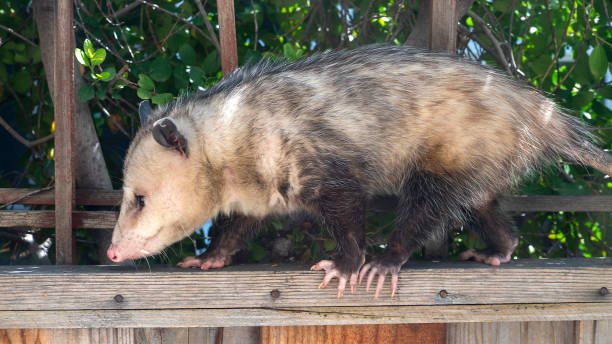
- Secondary wildlife intrusion. Vacated groundhog burrows are regularly taken over by skunks, opossums, and foxes. Solving the groundhog problem without closing the burrow can invite a second, different tenant.
- Garden and yard destruction. Groundhogs are strict herbivores with a strong preference for the tender growth in vegetable gardens. Clover, beans, peas, lettuce, squash, and nearly any garden crop is on their menu.
Signs You Have a Groundhog Under Your Deck or Porch
Groundhogs are not subtle tenants. Look for these signs around your deck or porch perimeter:
- A wide entrance hole, roughly 10 to 12 inches in diameter, typically with a crescent-shaped mound of freshly excavated dirt piled just outside it
- Multiple holes in the vicinity, as established burrows have one main entrance and up to four secondary exits or spy holes nearby
- Worn paths in the grass between the burrow entrance and nearby vegetation, reflecting the groundhog's regular foraging routes
- Daytime sightings of a large, brown, stocky animal with a short bushy tail. Unlike raccoons, groundhogs are diurnal and most active in the morning and late afternoon
- Chewed garden plants or stripped vegetable rows, often accompanied by visible bite patterns on stems close to ground level
- Soft or spongy ground near the deck perimeter, indicating tunneling activity just below the surface

The North Carolina Law You Need to Know Before You Do Anything
Important: In North Carolina, it is illegal to trap and relocate groundhogs. The NCWRC states clearly that trapped groundhogs must either be euthanized or released at the site of capture. You cannot drive one across the county and release it in a field. This is a hard rule, and it changes how removal works here compared to other states.
This matters because many homeowners picture a simple live-trap-and-relocate solution. That is not available in North Carolina. A groundhog trapped on your property stays on your property unless it is euthanized. This is one of the primary reasons professional wildlife removal makes more sense here than a hardware-store DIY approach, especially when young may be present in the burrow.
Outside of regulated trapping season, you can obtain a free depredation permit from the NCWRC that allows you to trap a groundhog causing property damage. Licensed Wildlife Control Agents can also handle removal directly, which is often the most practical path for a deck or foundation situation where proper exclusion work needs to follow removal.
Timing Matters: When to Act and When to Wait
In Alamance County, groundhogs emerge from hibernation in late February to early March. Females give birth in April, typically to litters of four to six pups. The young are weaned and mobile by late June to August, at which point they disperse to establish their own burrows.
The two best windows for removal and exclusion are:
- March to early April, right after emergence and before birth. This is the window to act if you discover a groundhog under your deck in late winter before a litter arrives.
- Late August through October, after the pups have dispersed and before the animal retreats into hibernation. This is the period the NCWRC's cooperative extension recommends for exclusion work.
If you suspect a litter is already present under your deck, removing only the mother creates a significant problem. Pups too young to forage will be trapped inside the burrow. A professional can assess whether young are present before proceeding, which avoids this outcome.
How to Get a Groundhog Out From Under Your Deck
What does not work
Before covering effective approaches, it is worth being clear about the common mistakes. Filling in the burrow entrance does not solve the problem. Groundhogs simply dig a new one, and blocking an entrance with an animal inside provokes it to dig its way out. Repellents, including ammonia, predator urine sprays, mothballs, and ultrasonic devices, are broadly ineffective once a groundhog is established. They may investigate your repellent and resume normal activity within hours.
Do not attempt to reach into a burrow or disturb it by hand. Cornered groundhogs can bite with their large incisors, which are capable of causing a serious wound.
Live trapping with proper legal handling
A cage trap placed just outside the main burrow entrance, baited with cantaloupe, apple slices, or sweet corn, is the most commonly used removal method. Placement matters: set it just outside the entrance but not directly over the hole, and orient it along the groundhog’s natural travel path. Check the trap frequently, as an animal left in a cage in summer heat can suffer rapidly.
Remember that under North Carolina law, a trapped groundhog must be released on-site or euthanized. A licensed Wildlife Control Agent handles this correctly and legally, which is a key reason professional removal is the recommended path for most Alamance County homeowners.
Exclusion fencing after removal
Removing the groundhog without installing an exclusion barrier is asking for the same problem again by next spring, possibly with a different animal. The NCWRC recommends installing a hardware cloth or chicken wire fence around the deck perimeter, at least 3 to 4 feet high and buried 12 inches underground with the bottom bent outward at a 90-degree angle to prevent digging under it. The top foot of fencing should be left loose or angled outward so it wobbles when a groundhog attempts to climb it.
For a deck that is already built, this work requires digging a trench around the perimeter, bending and securing the mesh, and backfilling, which is labor-intensive to do correctly. It is the permanent solution, and it also excludes skunks, opossums, and rabbits as a bonus.
My Recommendation for Alamance County Homeowners
I would not sit on this one. A groundhog that moved in under your deck in March has been digging since March. By June, the burrow system is significantly more extensive than the single hole you can see from outside. Every week of delay is more soil removed from under your footings and more potential for a secondary animal to claim the burrow if the original tenant leaves on its own.
Call a licensed Wildlife Control Agent, confirm the timing is right relative to any potential litter, and plan for exclusion fencing to be installed as part of the same job. Removal without exclusion is a temporary fix. Exclusion without confirmed removal risks sealing the animal inside. Both steps done together, done correctly, end the problem permanently.
If your deck has been hosting a groundhog for more than a season, it is also worth having someone check the footings before you do any repair work on the deck surface itself. You want to know what the ground actually looks like down there before you start nailing boards.